Kayla Harrison’s Coach Pushes Back After Dana White Calls Amanda Nunes Matchup “Greatest Women’s Fight of All Time
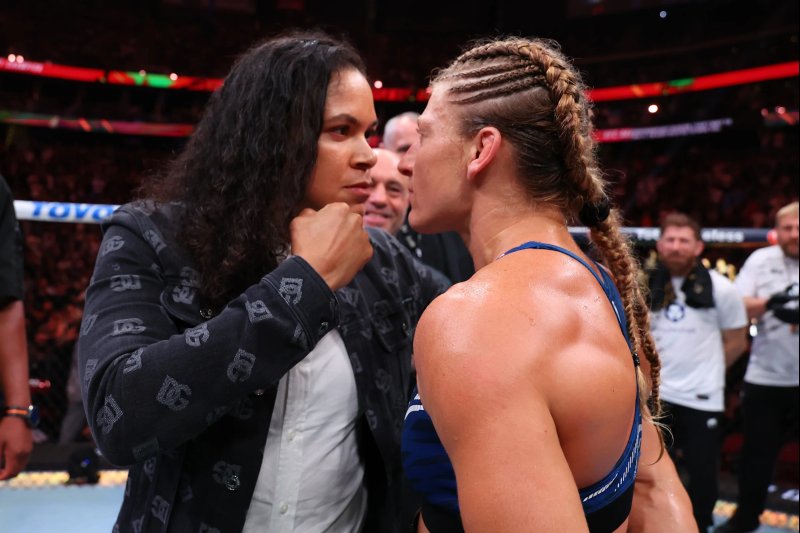
In the wake of comments from UFC President Dana White about a potential fight between Amanda Nunes and Kayla Harrison, Harrison’s head coach has publicly responded, offering a perspective that tempers the hype and reframes where his fighter’s priorities lie. The exchange touches on how elite athletes view legacy, comparisons to past stars, and the distinction between promotional talk and competitive reality.
The conversation began when White, speaking broadly about exciting potential fights in women’s MMA, referred to the idea of a matchup between UFC legend Amanda Nunes and two-division judo Olympic gold medalist Kayla Harrison as among the most intriguing possibilities. White described that hypothetical encounter as one of the greatest women’s fights that could be made — a statement that quickly echoed through fight media channels and among fans.
Amanda Nunes is widely regarded as one of the sport’s all-time greats. During her decade-long tenure in the UFC, she held titles in both the bantamweight and featherweight divisions, defended them multiple times, and earned a reputation for finishing fights in dominant fashion. Her success made her a defining figure in women’s MMA, and even after stepping away from active competition, her achievements remain a benchmark for excellence.
Kayla Harrison, meanwhile, has carved her own path in combat sports. A two-time Olympic gold medalist in judo, she transitioned to professional MMA with a high level of fan attention and expectation. Harrison quickly built an undefeated record and captured two PFL titles, establishing herself as one of the most accomplished women’s fighters outside the UFC. Her ventures into UFC competition have continued to draw interest, as she represents a rare crossover talent with elite credentials in both grappling and striking development.
When White elevated the Nunes-Harrison hypothetical to “greatest women’s fight of all time,” it was meant to convey the promotional allure of such a clash — two athletes with distinctive styles, dominant competitive résumés, and strong fan followings. Many fans and pundits enthusiastically agreed, seeing it as a blockbuster matchup that could transcend weight classes and historical comparisons.
However, Harrison’s coach offered a more grounded interpretation of White’s remarks. While not dismissing the significance of Nunes’s legacy, he emphasized that comparisons of this nature can overlook the specificity of each fighter’s journey and current competitive landscape. According to him, discussions about “greatest of all time” matchups should be rooted in the context of fighters’ careers and where they stand today, rather than be used as blanket superlatives.
The coach, speaking about White’s comments, made it clear that while the idea of a high-profile fight is understandable from a promotional standpoint, it doesn’t necessarily reflect his fighter’s immediate goals or mindset. He stressed the importance of focusing on what Harrison can control in her own competitive development, rather than being drawn into historical comparisons or subjective acclaim.
At the core of the coach’s response was an insistence on respect for the sport’s evolution. For him, both Nunes and Harrison occupy distinct chapters in women’s MMA — one as a dominant champion who helped define the sport’s early growth, and the other as an elite crossover athlete expanding the competitive map. Lumping both into a superlative label, he implied, can blur the unique significance of each fighter’s achievements.
“I think it’s fair to acknowledge what Amanda has done,” he said, referencing Nunes’s historic contributions. “But it’s not the way we look at it every day. We focus on preparing Kayla for the fights in front of her and letting history speak for itself.”
That perspective resonates with athletes and coaches who emphasize a game-by-game approach to competition. In highly stratified sports like MMA, where weight classes, stylistic matchups and timing all influence how careers unfold, comparing athletes across eras or disciplines can be challenging. Nunes’s legacy rests in the UFC’s bantamweight and featherweight arenas, while Harrison’s has spanned international judo success, professional MMA dominance in another organization, and now her own continued pursuit of titles under the UFC banner.
The coach also addressed what it means to elevate any matchup to “greatest fight” status. He suggested that while speculation and fan interest are valuable for building excitement, they can also create undue pressure or distracting narratives that don’t align with how competitors actually prepare. From his vantage point, the primary measure of greatness remains performance inside the cage, over time and against the best available opposition.
Harrison’s own competitive trajectory has been notable. After transitioning from Olympic judo into MMA, she fast became one of the sport’s most talked-about athletes. Her undefeated streak and accomplishments earned her a reputation as a force to be reckoned with, and her UFC run has kept her in the conversation among top contenders. That consistency and her ability to evolve as a mixed martial artist are what his coach emphasizes when discussing her legacy — not who she might fight in hypothetical matchups.
For supporters of Nunes, the idea of a cross-discipline showdown with Harrison represents a fascinating clash of styles and achievements. Nunes dominated the UFC’s champion ranks for years, and her resume includes victories over multiple Hall of Fame-caliber opponents. Her competitive spirit and finishing ability made her one of the most feared fighters of her generation.
Yet from the coaching standpoint, the focus remains on respect and context rather than promotional hyperbole. “We respect what Amanda has done,” he said. “That’s not the issue. But you don’t win anything by talking about fights that aren’t scheduled. You win by getting better each day and earning your way into the fights that matter.”
That comment underscored a broader theme — greatness, in the coach’s view, is earned incrementally, through preparation and performance. And while Nunes’s accomplishments can be celebrated, labeling an unscheduled hypothetical as “the greatest fight” carries implications beyond the fighters themselves.
As conversation around potential matchups continues in MMA media and fan circles, the exchange highlights how athletes and those closest to them can perceive promotional commentary differently than casual observers. What may be framed as exciting speculation for audiences can be interpreted by coaches as distraction from the work at hand.
Ultimately, the coach’s response shows where his priorities lie: not in debate about all-time status or marquee billing, but in focused preparation and measured respect for the sport’s competitive hierarchy. For Harrison and her team, greatness is a process — one defined by incremental achievement, strategic goals and respect for the challenges that lie ahead.




Login with Email or Google
Be the first to comment!